


CALL TO SCHEDULE YOUR PACKAGE!
+9198460 43403
+91 484 4010403
CALL TO SCHEDULE YOUR PACKAGE!
+9198460 43403
+91 484 4010403
The commercial capital of Kerala and the most cosmopolitan of Kerala’s cities, Cochin is a fascinating blend of cultures. From time immemorial, it has been the favorite destination of globe-trotters and explorers. Blessed by one of the finest natural harbors in the world, Cochin has been eulogised as the Queen of the Arabian Sea.
In and around Cochin are several cities of monumental value, but step into Fort Cochin, and you are in a totally different world. The Chinese fishing nets, the Jewish Synagogue, the Dutch palace, the Portuguese and British Architecture, all finely blend with the rich heritage of the land, intricately woven folklore and fact.
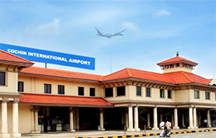 With an international airport, an international sea port and a busy network of road and rail transport, the city is well connected to the rest of the world.You can either board a bus or hire a three-wheeled auto rickshaw. If you prefer the ferry, the trip begins either from the Main Boat Jetty or the Terminus Jetty near Willington Island.
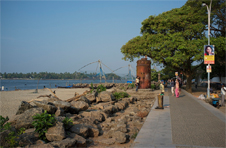 Walking through this old Portuguese settlement at a leisurely pace, will take you up to an hour and a half. The most pleasant time for the walk is between 9 am and 12 noon or between 3 pm and 6 pm. The most ideally suited attire in this sub tropical country is cottons and soft walking shoes or thong. A wide-brimmed straw hat is of great help on a sunny day.
 "If China is where you make your money, then Cochin is surely the place to spend it."
When Nicolas Conti, the legendary Italian traveler said this, Cochin was flourishing in trade as one of the most desirable destinations approachable by sea. And Fort Cochin, once an obscure fishing hamlet, found itself at the hub of all this bustling activity. It was soon to be the first European township in trade as one of the most glorious cities in its history.
"If China is where you make your money, then Cochin is surely the place to spend it."
When Nicolas Conti, the legendary Italian traveler said this, Cochin was flourishing in trade as one of the most desirable destinations approachable by sea. And Fort Cochin, once an obscure fishing hamlet, found itself at the hub of all this bustling activity. It was soon to be the first European township in trade as one of the most glorious cities in its history.
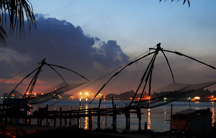
Fort Cochin probably has the best preserved history of colonial times and the ideal way to bring it alive is to take a walk down its old colonial roads, with its tree-lined avenues and quaint little lands and beside the seashores – where magnificent Chinese fishing nets sketch a spectacular skyline. It is believed that Chinese travelers during the reign of Kubla Khan had introduced this art of Chinese fishing to Cochin.
In AD 1341, a cataclysmic flood threw open the estuary at Cochin. Thanks to the strange ways of nature, out of this land-locked area was born one of the finest natural harbors of the east. This in turn paving the way for a deluge of seafaring visitors, from the Arabs to the Chinese and later, from the Portuguese to the British. The features of the latter ones characterize the façade of Fort Cochin, to a great extent.
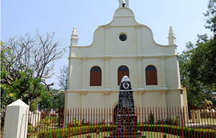 Walking through Fort Cochin will transport you back to the last years of the 15th century. When the adventurous Vasco da Gamma and valiant Cabral let their religions to this land lured by the fabulous riches of Malabar Coast and established flourishing trade relations.
In 1553 with the permission of Maharaja of Cochin, Fort Immanuel , the first European Fort in India was constructed here. Within its vast confines, the Portuguese built houses, Churches and other buildings while generously contributing to the indigenous cultural fabric, the standard of which still endures.
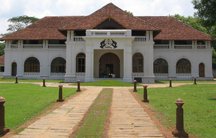 While traveling down the streets of Fort Cochin, the Dutch influence is profound, they laid out most of the town in its present form. In doing this, they cut down the Fort to about a third of its original extent, when they wrested it from the Portuguese in AD 1663. During the Dutch era, Fort Cochin climbed the heights of fame as a rich commercial center, major military base, an illustrious cultural hub, a noted ship building yard and an age old center of Christianity.
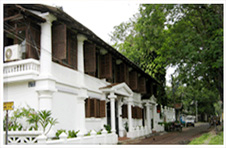 The last side of colonial regime seen at the Fort Cochin are those of British, who took over the town in 1795.After those glorious years it was then relegated to the role of an administrative outpost. Yet, the spices and tea trade kept it in the lime light. In many of the Bungalows here, you will notice the grandeur of European Villa; evidence of distinct strain of Indo/European Architecture that matured mostly in this period.
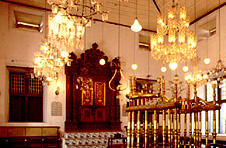 After the enlightening walk through Fort Cochin, and if ones curiosity is still asking for more, walk on for the Jewish settlements of Mattancherry is just 20 minutes away. The Dutch Palace and the Jewish Synagogue, that are over 400 years old, are places where you can treat be immersed in the glorious past of this land.
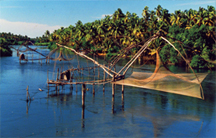 These huge cantilevered fishing nets are the legacy of one of the first visitors to Malabar Coast. Erected here between 1350 and 1450 AD by traders from the Court of Kubla khan, these nets are set up on teak wood and bamboo poles. The best place to watch the net being lowered into the sea and catch being brought in is Vasco da Gamma square, a narrow promenade that runs along along the Beach. The square is an ideal place to idle with stalls serving fresh delicious sea food and tender coconuts.
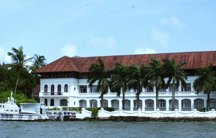 This charming Mansion was the office of Pierce Leslie & Co., coffee merchants, founded in 1862. A representative of Fort Cochin Colonial Bungalow, this building reflects Portuguese, Dutch and local influences. Characteristic features are wood panels that form the roof of ground floor, arched doorways, carved doors and sprawling rooms. Water front verandas are always an added attraction to such house.
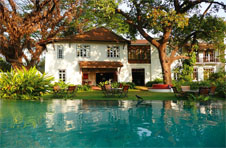 This house that was once a boat house and built in 1808 is the possession of Carrit Moran & Co. renowned Tea brokers, who used it as their residence and later converted into heritage hotel. Situated in the Princess Street, it is one of the oldest hotel in the city. The building is a combination of Dutch and Portuguese architecture. You can find a large arched entrance here and the roofs are red-tiled. You can also find a well- maintained beautiful garden infront of the building.
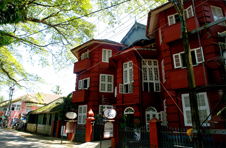 This magnificent building constructed by Samuel. S. Koder of the Cochin Electric Company in 1808 is a supreme example of transition from colonial to Indo-European Architecture. Features like Veranda Seats at the entrance, floor tiles set in a chess board pattern, red colored brick like façade, carved wood furniture and a wooden bridge connecting to separate structure across the street are unique to this Bungalow.
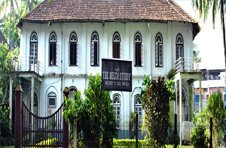 Once a warehouse, this heritage Bungalow built in 1808 is presently a high school with the same name. Delta Study is located in Fort Kochi. The school here was established in 1976 and now is one of the best schools in Kochi.
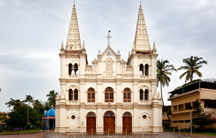 This historic Church was built by the Portuguese and elevated to a Cathedral by Pope Paul IV in 1558. In 1795 it fell into the hands of the British when they took over Cochin, and was demolished.
In 1887 Bishop Dom Gomes Ferreira commissioned a new building at the same site. The Church has since been proclaimed a Basilica in 1984 by Pope John Paul II.
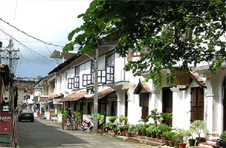 One of the earliest streets to be constructed in Fort Cochin, Princess Street with its European style residences still retain its world charm. At princess street, you can find antique stores, cigar shops, provisional stores, cafes, restaurants, art galleries etc. All these will be a different experience for you. To get the best view of this quaint street, you can move on to loafer's corner. It is a meeting place, which connects princess street, peter celli street and bastion street. The traditional meeting place and hangout of the jovial locals of this area.
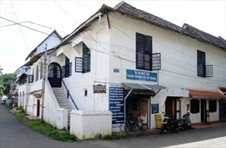 Vasco House in the Rose Street, Fort Kochi is said to be used by Vasco da Gama during his visit to Kochi until 1524. This house is more than 500 years old. The building is of Portuguese architecture and considered to be the pioneer among the European style of building in Kochi. You can find a large glass-panned windows, opening towards the St. Francis Church, European style windows, balconies, verandahs etc. All these will make you remember the grand old days of Fort Kochi. Now the Vasco House is a homestay loved by most of the tourists.
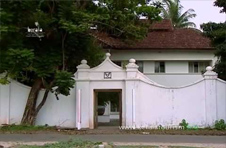 The large wooden gate facing the parade ground with monogram (VOC) of the once mighty Dutch East India Company carved on it was built in 1740.
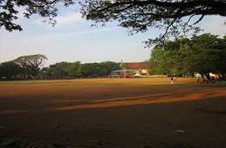 With St. Francis Church on one side and VOC Gate and Cochin Club on other sides, Parade Ground at Fort Kochi remains one of the beautiful historical sites in Kochi. The ground was earlier known as Baracca Maidan. The parade ground is an open ground covering four acres. The colonists conducted their military parades and drills. The building around the ground housed their defense establishments. Today, the largest open ground in Fort Cochin, the parade ground is a sports arena. It is now a selected venue of Ranji trophy and All India Rugby Football Tournament.
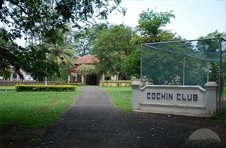 One of the four elite clubs of British Cochin, the United Club today serves two roles- as a class room for the nearby St. Francis Primary School by day and card room for the current listed members by evening. Until 1907 the building housed the offices of Fort Cochin Municipality.
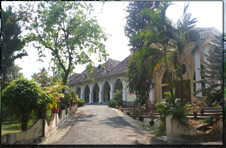 Built in 1506 as the residence of the Portuguese Governor, the Bishop’s House stands on a little hillock near Parade Ground. The façade of the house is characterized by large Gothic Arches and has a circular garden path winding up to the main entrance. The building was acquired by Dome Jos Gomes Ferreira, the 27th Bishop of the Diocese of Cochin whose jurisdiction extended over Burma, Malaya and Ceylon in addition to India. A powerful man for his time.
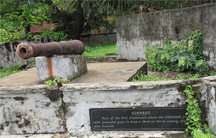 This bastion of the Portuguese in Cochin was a symbol of the strategic alliance between the Maharajah of Cochin and the Monarch of Portugal, after whom it was named. Built in 1503, the fort was reinforced in 1538. By 1806 the Dutch, and later the British, had destroyed most of the fort walls and its bastions. Today, remains of this once imposing structure can be seen along the beach.
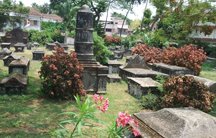 The tomb stones here are the most authentic record of the hundreds of Europeans who left their homeland on a mission to expand their colonial empires and changed the course of history of this land. The cemetery was consecrated in 1724 and is today managed by the Church of South India.
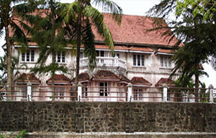 This graceful building holds within itself a reflection of the colonial era. The Bungalow was built on the site of the Gelderland Bastion, one of the seven Bastions of the old Dutch fort. Earlier known as Kunal or Hill Bungalow, it was home to the managers of the National Bank of India during the British reign. Today, the Bungalow belongs to Ram Bahadur Thakur and Co., the renowned Tea Trading firm.
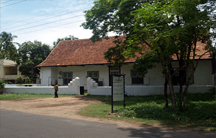 Though built around 1695 by the Dutch East India Company, David Hall gets its name from one of its later occupants, David Koder, a Jewish business man. The Hall was originally associated with Hendrik Adriaan van Reed tot Drake stein, renowned Dutch commander better known for his 'Hortus Malavaricus', a pioneering compilation of the flora of the Malabar coast.
The club, with its impressive library and a collection of sporting trophies, is housed in a beautifully landscaped park. In the earl